Understanding the Two Engagement Models
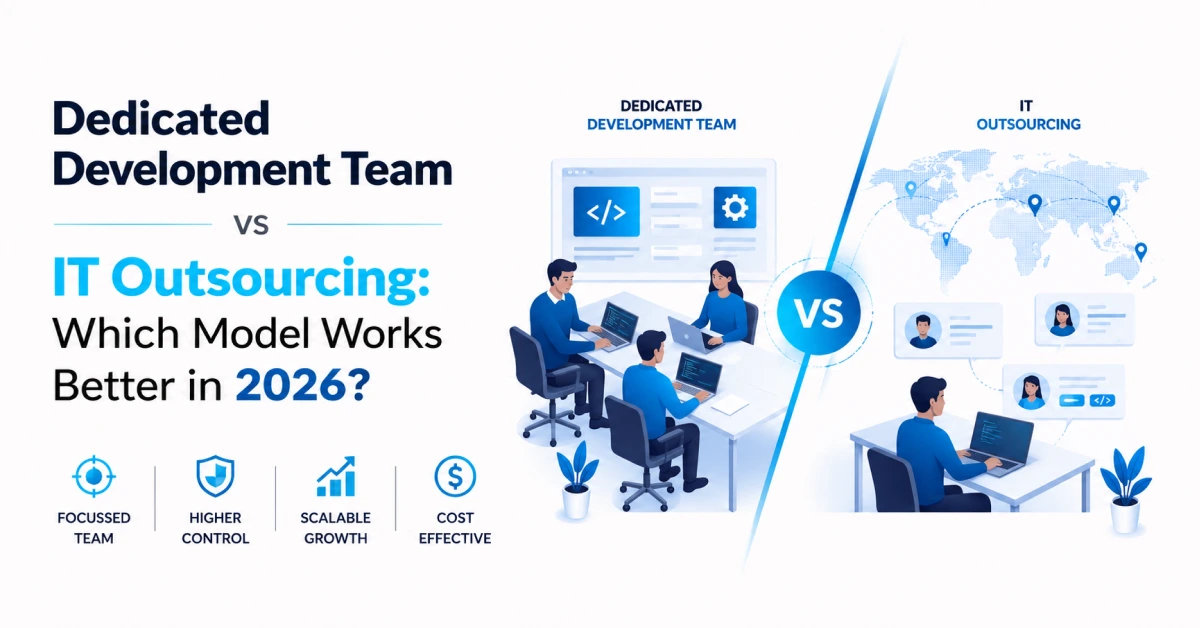
When scaling your software development capacity, two primary engagement models dominate the market: hiring a dedicated development team and outsourcing to an IT outsourcing partner. Each model serves different business needs, budgets, and project complexities. Understanding their fundamental differences is the first step toward making the right choice for your organization in 2026.
A dedicated development team model involves hiring remote developers who work exclusively on your project. These professionals become an extension of your in-house team, reporting to your management and following your processes. According to a 2025 Deloitte Global Outsourcing Survey, 57% of companies now prefer dedicated team models for core development work because of the greater control and alignment they offer.
IT outsourcing, on the other hand, involves contracting a third-party vendor to deliver a defined scope of work. The vendor manages the team, infrastructure, and delivery timelines. The global IT outsourcing market is projected to reach $587.3 billion by 2027 (Grand View Research), driven by cost arbitrage and access to specialized skills.
The choice between these two models has significant implications for your project cost, quality, timeline, and intellectual property protection. In this comprehensive guide, we break down every factor you need to consider before making your decision.
Cost Comparison: Upfront Investment vs Long-Term Value
Cost is often the first consideration for business owners evaluating development models. However, the true cost extends far beyond hourly rates.
Dedicated Team Pricing Structure
With a dedicated team, you typically pay a monthly retainer based on team composition. For example, a team comprising one senior developer ($80-120/hour), one mid-level developer ($50-75/hour), and one QA engineer ($40-60/hour) in Eastern Europe or Latin America would cost approximately $25,000-40,000 per month. This includes salaries, management overhead, and tooling but excludes recruitment and onboarding costs.
IT Outsourcing Pricing Structure
Outsourcing is typically project-based or time-and-materials. A fixed-price contract for a medium-complexity web application might range from $50,000 to $150,000, depending on specifications. The 2026 Clutch Developer Survey found that outsourced projects average 18% lower total cost than dedicated teams over a 12-month period — but this gap narrows for projects exceeding 18 months.
Key insight: For projects under 6 months, outsourcing is almost always cheaper. For ongoing development (12+ months), a dedicated team delivers better ROI through accumulated domain knowledge and faster velocity.
Control and Cultural Alignment
Control over the development process is where these two models diverge most significantly. A dedicated team integrates with your company culture, communication channels, and workflows. Your product manager or CTO directly oversees daily work, sprint planning, and code reviews. This model is ideal for companies with an existing technical leadership team that can provide direction and mentorship.
Outsourcing transfers control to the vendor. While reputable outsourcing firms assign a dedicated project manager, your visibility into day-to-day operations is limited. This can work well for well-defined projects with clear requirements but creates risk when requirements evolve. The 2025 State of IT Outsourcing Report found that 42% of outsourcing failures stemmed from misaligned expectations around control and communication.
If your startup is building a core product that requires constant iteration and strategic pivots, the dedicated team model’s alignment advantage is difficult to overstate.
Communication and Time Zone Considerations
Communication friction is one of the most underestimated costs in distributed development. Dedicated teams often operate within overlapping time zones (Latin America for US companies, Eastern Europe for European companies). CloudMatrix Technologies, based in Boston, Massachusetts, recommends at least 4 hours of overlap between your in-house team and the dedicated team for effective agile ceremonies.
Outsourcing vendors may be in more distant time zones (India, Philippines, Southeast Asia), offering cost advantages but creating asynchronous communication challenges. Some companies successfully manage this with well-documented requirements and daily standup meetings across time zones. However, for complex, creative development work requiring real-time collaboration, time zone alignment often justifies the higher cost of a dedicated team.
Intellectual Property and Security
IP protection is a critical consideration, particularly for startups building proprietary technology. With a dedicated team, IP agreements are typically straightforward — work-for-hire contracts ensure your company retains full ownership. Developers sign NDAs and work within your secure infrastructure.
Outsourcing arrangements require more careful contract structuring. While reputable IT outsourcing firms have standard IP protection clauses, the multi-client nature of outsourcing creates inherent risk. A 2024 survey by the International Association of Outsourcing Professionals found that 23% of companies experienced IP-related disputes in outsourced projects versus only 4% with dedicated teams.
Scalability and Flexibility
Scaling a dedicated team up or down takes time — typically 3-6 weeks to recruit and onboard new members. However, once onboard, dedicated team members have deep context and can contribute immediately to new initiatives. This model suits companies with predictable, sustained development needs.
Outsourcing vendors can scale teams rapidly, often within days, by pulling from their bench of pre-vetted developers. This flexibility is valuable for shorter projects with tight deadlines. However, each new developer must still ramp up on your project, and context switching between multiple client projects can reduce velocity.
Quality and Expertise Access
Both models can deliver high-quality work, but the expertise profile differs. Dedicated teams allow you to hand-select each team member, conducting your own technical interviews and culture-fit assessments. This is valuable when you need very specific expertise (e.g., a React Native developer with fintech experience).
Outsourcing vendors provide access to a broad talent pool and can assemble multi-disciplinary teams quickly. Top-tier outsourcing firms invest heavily in training and certification programs. CloudMatrix’s software development services exemplify how outsourcing vendors can combine deep expertise across domains while maintaining quality standards through internal processes.
Team Composition and Skill Sets
The composition of your development team differs significantly between the two models. With a dedicated team, you have the flexibility to choose each team member based on specific technical requirements. You might need a senior React developer, a Python backend engineer, a DevOps specialist, and a QA engineer — you handpick each role. This granular control ensures your team has exactly the skills your project demands, but it also means you invest time in recruitment and vetting.
Outsourcing vendors typically provide pre-assembled teams based on your project requirements. These teams are built from a pool of vetted developers, which can accelerate the hiring process. However, you generally accept the vendor’s assessment of team composition rather than making individual hiring decisions. According to a 2025 Stack Overflow Developer Survey, 68% of tech leaders reported that finding the right skill combinations was easier with outsourcing vendors due to their broader talent pools.
At CloudMatrix Technologies, we help businesses evaluate their team structure needs before committing to either model. Our experience with both dedicated teams and outsourced development allows us to provide unbiased recommendations based on your specific project requirements and budget constraints.
Project Management and Methodology
Agile methodology works well with both models, but the implementation differs. Dedicated teams typically participate fully in your agile ceremonies — daily standups, sprint planning, retrospectives. They become integrated members of your product development organization, attending the same meetings and using the same project management tools as your in-house team. This integration creates a unified development culture and shared understanding of project goals.
Outsourcing teams often follow their own project management methodology, with a vendor-side project manager serving as the bridge between your organization and the development team. While this can work effectively for well-defined projects, it introduces an additional communication layer that can slow down decision-making. The 2025 PMI Pulse of the Profession report found that projects with integrated, cross-vendor agile teams were 1.6x more likely to meet their original goals than those with separate, vendor-managed workflows.
Risk Management and Mitigation
Both engagement models carry distinct risks. With dedicated teams, the primary risks are: longer ramp-up time if team members don’t work out, higher fixed costs during slow periods, and dependency on specific individuals. Mitigation strategies include phased hiring, clear performance metrics, and cross-training within the team.
With outsourcing, the primary risks are: less control over day-to-day work, potential communication gaps, intellectual property concerns, and vendor lock-in. Mitigation strategies include detailed contracts with clear SLAs, regular milestone reviews, IP protection clauses, and maintaining internal technical oversight. CloudMatrix’s software development services are structured with transparent reporting and milestone-based delivery to minimize these risks.
Long-Term Strategic Considerations
Your choice between dedicated teams and outsourcing should align with your long-term technology strategy. Companies building a core technology platform that will evolve over years should lean toward dedicated teams that accumulate deep institutional knowledge. Companies executing defined projects with clear endpoints — especially when exploring new technology domains — can benefit from the flexibility and specialized expertise of outsourcing partners.
Consider also the impact on your internal team dynamics. Dedicated external team members can become trusted long-term collaborators, while rotating outsourced teams can make it harder to maintain consistent code quality and architectural vision. Whichever path you choose, invest in documentation, knowledge management, and regular knowledge transfer sessions.
Team Composition and Skill Sets
The composition of your development team differs significantly between the two models. With a dedicated team, you have the flexibility to choose each team member based on specific technical requirements. You might need a senior React developer, a Python backend engineer, a DevOps specialist, and a QA engineer — you handpick each role. This granular control ensures your team has exactly the skills your project demands, but it also means you invest time in recruitment and vetting.
Outsourcing vendors typically provide pre-assembled teams based on your project requirements. These teams are built from a pool of vetted developers, which can accelerate the hiring process. However, you generally accept the vendor’s assessment of team composition rather than making individual hiring decisions. According to a 2025 Stack Overflow Developer Survey, 68% of tech leaders reported that finding the right skill combinations was easier with outsourcing vendors due to their broader talent pools.
At CloudMatrix Technologies, we help businesses evaluate their team structure needs before committing to either model. Our experience with both dedicated teams and outsourced development allows us to provide unbiased recommendations based on your specific project requirements and budget constraints.
Project Management and Methodology
Agile methodology works well with both models, but the implementation differs. Dedicated teams typically participate fully in your agile ceremonies — daily standups, sprint planning, retrospectives. They become integrated members of your product development organization, attending the same meetings and using the same project management tools as your in-house team. This integration creates a unified development culture and shared understanding of project goals.
Outsourcing teams often follow their own project management methodology, with a vendor-side project manager serving as the bridge between your organization and the development team. While this can work effectively for well-defined projects, it introduces an additional communication layer that can slow down decision-making. The 2025 PMI Pulse of the Profession report found that projects with integrated, cross-vendor agile teams were 1.6x more likely to meet their original goals than those with separate, vendor-managed workflows.
Risk Management and Mitigation
Both engagement models carry distinct risks. With dedicated teams, the primary risks are: longer ramp-up time if team members don’t work out, higher fixed costs during slow periods, and dependency on specific individuals. Mitigation strategies include phased hiring, clear performance metrics, and cross-training within the team.
With outsourcing, the primary risks are: less control over day-to-day work, potential communication gaps, intellectual property concerns, and vendor lock-in. Mitigation strategies include detailed contracts with clear SLAs, regular milestone reviews, IP protection clauses, and maintaining internal technical oversight. CloudMatrix’s software development services are structured with transparent reporting and milestone-based delivery to minimize these risks.
Long-Term Strategic Considerations
Your choice between dedicated teams and outsourcing should align with your long-term technology strategy. Companies building a core technology platform that will evolve over years should lean toward dedicated teams that accumulate deep institutional knowledge. Companies executing defined projects with clear endpoints — especially when exploring new technology domains — can benefit from the flexibility and specialized expertise of outsourcing partners.
Consider also the impact on your internal team dynamics. Dedicated external team members can become trusted long-term collaborators, while rotating outsourced teams can make it harder to maintain consistent code quality and architectural vision. Whichever path you choose, invest in documentation, knowledge management, and regular knowledge transfer sessions.
FAQ — Dedicated Team vs IT Outsourcing
Which is more cost-effective for a startup in 2026?
For seed-stage startups with limited capital, IT outsourcing is typically more cost-effective for building an initial MVP. Once the product achieves product-market fit and requires continuous iteration, transitioning to a dedicated team model often provides better long-term value.
Can I switch from outsourcing to a dedicated team mid-project?
Yes, but plan for a transition period of 4-8 weeks. Document all code, architecture decisions, and processes before transitioning. Some companies use a hybrid model — outsourcing specific modules while maintaining a dedicated core team.
How do I evaluate an outsourcing vendor’s quality?
Request case studies, client references, and code samples. Conduct technical interviews with the proposed team members. Ask about their quality assurance processes, and request a small paid pilot project before committing to a large engagement.
Is a dedicated team model only for large enterprises?
No. Mid-sized companies and well-funded startups increasingly use dedicated teams. The model works best when you have internal technical leadership to provide direction and when your project requires 6+ months of continuous development.
What hidden costs should I watch for?
For outsourcing: scope creep charges, knowledge transfer fees, and termination penalties. For dedicated teams: recruitment agency fees (15-25% of annual salary), equipment costs, and management overhead. Budget an additional 15-20% on top of visible costs.
Conclusion: Making the Right Choice for Your Business
The decision between a dedicated development team and IT outsourcing ultimately depends on your project complexity, duration, and strategic importance. Choose a dedicated team when you need deep product ownership, ongoing iteration, and tight integration with your culture. Choose IT outsourcing when you have well-defined requirements, fixed budgets, and need to validate an idea quickly.
Many successful companies use a hybrid approach — starting with outsourcing for initial development and transitioning to a dedicated team for long-term product evolution. If you’re unsure which model fits your needs, contact CloudMatrix Technologies for a consultation. Our team has experience delivering both models for businesses across Massachusetts and the United States.