The Build vs Buy Software Decision: A Strategic Framework
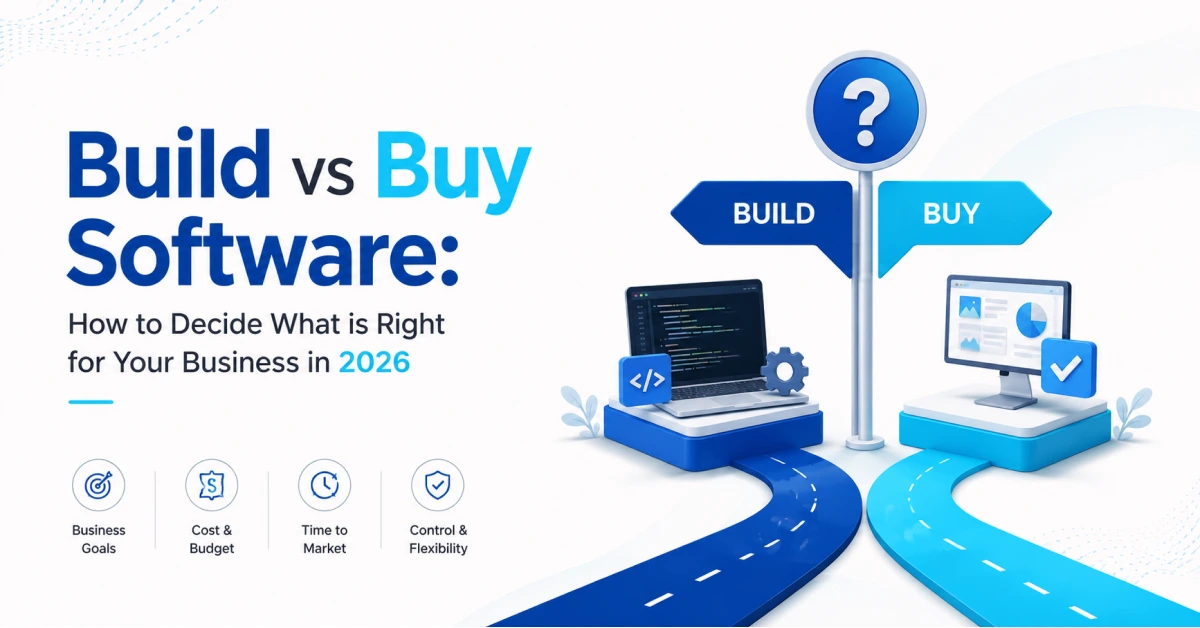
The build vs buy software decision is one of the most consequential choices a business leader can make. Building custom software offers complete control and competitive differentiation. Buying off-the-shelf software provides speed, lower upfront cost, and proven functionality. Getting this decision wrong can cost your organization hundreds of thousands of dollars and months of lost time.
According to McKinsey’s 2025 Digital Transformation Report, companies that made build vs buy decisions using a systematic evaluation framework were 3.2x more likely to achieve their digital transformation goals within budget. This guide provides that framework, drawing on real-world examples and industry data to help you make the right call for your business in 2026.
When Building Custom Software Makes Sense
Your Processes Are Your Competitive Advantage
If your business operates on unique workflows that differentiate you from competitors, custom software lets you encode those workflows directly into your technology stack. A logistics company with a proprietary route-optimization algorithm, for example, would struggle to find an off-the-shelf solution that captures their competitive edge. CloudMatrix’s software development services help businesses in Boston and across the US build custom solutions that become strategic assets.
Integration Requirements Are Complex
When your existing tech stack includes legacy systems, custom APIs, or industry-specific compliance requirements (HIPAA, SOC 2, PCI-DSS), off-the-shelf solutions often fall short. Building custom middleware or a full-stack application gives you control over data flow, security, and compliance. The 2025 Gartner IT Budget Report found that 38% of companies that tried to integrate off-the-shelf solutions into complex environments exceeded their integration budgets by 50% or more.
Scalability Is a Long-Term Priority
Off-the-shelf software typically scales through subscription tiers, which can become prohibitively expensive. Custom software, while requiring higher upfront investment, gives you linear cost scaling. For businesses projecting 3x+ growth within 24 months, building custom often becomes cheaper than buying at scale.
When Buying Off-the-Shelf Software Wins
Speed to Market Is Critical
If you need a solution operational within weeks rather than months, off-the-shelf software is the clear winner. The average custom development project takes 4-9 months from concept to deployment, while SaaS solutions can be implemented in days. For startups racing to validate a business model, this speed advantage can be decisive.
Core Business Functions Have Mature Solutions
For functions like accounting, HR, CRM, and email marketing, the market offers mature, battle-tested solutions. Salesforce for CRM, HubSpot for marketing, and QuickBooks for accounting are excellent examples. Building custom alternatives for these functions rarely provides meaningful competitive advantage. Cloud solutions particularly shine in these scenarios, offering rapid deployment with enterprise-grade reliability.
Total Cost of Ownership Is Lower at Small Scale
For organizations with under 50 users evaluating standard business tools, off-the-shelf solutions almost always have a lower total cost of ownership. The subscription model eliminates maintenance, hosting, security updates, and support costs that custom software requires.
Total Cost of Ownership Analysis
A comprehensive TCO analysis should include: development costs (upfront + ongoing), infrastructure costs, maintenance (20-30% of development cost annually), training costs, opportunity cost of delayed deployment, and cost of vendor lock-in. The break-even point for custom software typically occurs between 18 and 36 months of operation. Beyond that horizon, custom software’s TCO advantage grows significantly.
The Hybrid Approach: Best of Both Worlds
Many sophisticated organizations use a hybrid strategy. They buy mature, commoditized solutions for non-core functions (HR, finance, email) and build custom software for their core differentiators. This approach minimizes risk while investing in capabilities that create competitive separation. IT consulting and training can help your organization develop a build vs buy roadmap tailored to your situation.
Evaluating Total Cost of Ownership
Total cost of ownership (TCO) provides the most accurate comparison between building and buying software. TCO includes all costs associated with a software solution over its entire lifecycle — not just the initial purchase or development price. For off-the-shelf software, TCO includes licensing fees, implementation costs, customization expenses, integration costs, training, support subscriptions, and upgrade fees.
For custom software, TCO includes development costs, infrastructure hosting, ongoing maintenance (typically 20-30% of initial development annually), security updates, feature enhancements, documentation, and internal support overhead. The 2026 Gartner TCO Analysis found that custom software becomes cost-neutral compared to off-the-shelf solutions at approximately 24 months for mid-complexity business applications.
Security and Compliance Considerations
Security requirements significantly influence the build vs buy decision. Off-the-shelf software from established vendors typically has dedicated security teams, regular penetration testing, and compliance certifications (SOC 2, ISO 27001). However, shared infrastructure means that vulnerabilities in the vendor’s platform can affect your data.
Custom software gives you complete control over your security architecture. You can implement security measures tailored to your specific threat model, compliance requirements, and data sensitivity. For businesses handling sensitive customer data, operating in regulated industries (healthcare, finance, legal), or building intellectual property, the security advantages of custom software often justify the higher initial investment.
User Adoption and Training
User adoption is frequently overlooked in the build vs buy analysis. Off-the-shelf software benefits from established user interfaces, training materials, and community support. New employees may already be familiar with popular platforms like Salesforce, Slack, or Microsoft 365, reducing ramp-up time. Maintenance training costs are also lower because third-party vendors produce and update documentation, tutorials, and certification programs.
Custom software requires investment in user training, documentation creation, and ongoing support. However, custom software can be designed around your exact workflows and user personas, potentially making it more intuitive for your specific team. Well-designed custom interfaces that mirror existing workflows often achieve higher adoption rates than generic off-the-shelf solutions that force users to adapt to the software’s paradigm.
Evaluating Total Cost of Ownership
Total cost of ownership (TCO) provides the most accurate comparison between building and buying software. TCO includes all costs associated with a software solution over its entire lifecycle — not just the initial purchase or development price. For off-the-shelf software, TCO includes licensing fees, implementation costs, customization expenses, integration costs, training, support subscriptions, and upgrade fees.
For custom software, TCO includes development costs, infrastructure hosting, ongoing maintenance (typically 20-30% of initial development annually), security updates, feature enhancements, documentation, and internal support overhead. The 2026 Gartner TCO Analysis found that custom software becomes cost-neutral compared to off-the-shelf solutions at approximately 24 months for mid-complexity business applications.
Security and Compliance Considerations
Security requirements significantly influence the build vs buy decision. Off-the-shelf software from established vendors typically has dedicated security teams, regular penetration testing, and compliance certifications (SOC 2, ISO 27001). However, shared infrastructure means that vulnerabilities in the vendor’s platform can affect your data.
Custom software gives you complete control over your security architecture. You can implement security measures tailored to your specific threat model, compliance requirements, and data sensitivity. For businesses handling sensitive customer data, operating in regulated industries (healthcare, finance, legal), or building intellectual property, the security advantages of custom software often justify the higher initial investment.
User Adoption and Training
User adoption is frequently overlooked in the build vs buy analysis. Off-the-shelf software benefits from established user interfaces, training materials, and community support. New employees may already be familiar with popular platforms like Salesforce, Slack, or Microsoft 365, reducing ramp-up time. Maintenance training costs are also lower because third-party vendors produce and update documentation, tutorials, and certification programs.
Custom software requires investment in user training, documentation creation, and ongoing support. However, custom software can be designed around your exact workflows and user personas, potentially making it more intuitive for your specific team. Well-designed custom interfaces that mirror existing workflows often achieve higher adoption rates than generic off-the-shelf solutions that force users to adapt to the software’s paradigm.
FAQ — Build vs Buy Software
How do I calculate the ROI of building custom software?
Include direct savings from eliminated manual processes, revenue from new capabilities, competitive advantage valuation, and reduction in vendor licensing costs. A thorough ROI analysis requires financial modeling with 3-5 year projections.
What is the minimum budget for custom software development?
Simple custom applications start around $30,000-50,000. Mid-complexity solutions range from $80,000-200,000. Enterprise-grade systems can exceed $500,000.
How long does custom software development take?
An MVP takes 2-4 months. A full-featured application takes 6-12 months. Ongoing development continues throughout the software’s lifecycle.
Can I start with off-the-shelf and migrate to custom later?
Yes, this is a common and recommended approach. Start with off-the-shelf to validate workflows, then build custom when limitations become costly enough to justify the investment.
Case Studies: Build vs Buy in Action
Examining real-world examples helps illustrate when each approach makes sense. Consider a mid-sized logistics company managing a fleet of 50 delivery vehicles. They evaluated off-the-shelf fleet management software ranging from $500-2,000/month, but none supported their unique route-optimization algorithm or integrated with their legacy warehouse management system. After a detailed TCO analysis, they chose to build custom software for $180,000. Within 18 months, the custom solution reduced delivery costs by 22% and improved on-time delivery rates from 89% to 97%, delivering a clear ROI that no off-the-shelf solution could match.
In contrast, a professional services firm needing a CRM system evaluated building custom software at an estimated $120,000 vs purchasing Salesforce at $1,200/seat/year for their 40-person team. The five-year TCO for custom development was $290,000 (including maintenance) vs $360,000 for Salesforce. However, considering that Salesforce required no development time, had immediate deployment, and included enterprise-grade support, the firm chose Salesforce. The 18-month head start on implementation allowed them to generate an additional $200,000 in revenue from improved lead tracking — a benefit that tipped the scales decisively toward buying.
These contrasting examples highlight a crucial lesson: the build vs buy decision cannot be made purely on cost. Strategic factors — competitive differentiation, time to market, core vs non-core functionality — often carry more weight than direct financial comparisons. CloudMatrix Technologies provides build vs buy consulting that considers all these dimensions.
Vendor Evaluation Framework for Buying
If your analysis points toward buying, use a structured vendor evaluation framework. Start by defining must-have vs nice-to-have features. Evaluate each vendor against criteria including: feature completeness and fit, integration capabilities with existing systems, total cost over 3-5 years, vendor reputation and financial stability, customer support quality, security certifications and data protection, scalability and performance, user experience and adoption rates, training and onboarding support, and vendor lock-in risk and data portability. Score each vendor on a weighted scale and conduct proof-of-concept trials with the top candidates before making a final decision.
Technical Debt and Long-Term Maintenance
Technical debt is an often-overlooked factor in the build vs buy decision. Custom software inevitably accumulates technical debt as requirements evolve, team members come and go, and quick fixes are implemented under time pressure. Over a 5-year period, technical debt remediation can add 15-30% to the total cost of ownership for custom software. Strong engineering practices — code reviews, automated testing, continuous integration, and regular refactoring — can minimize but never eliminate technical debt.
Off-the-shelf software also carries hidden costs. Vendor lock-in makes it difficult and expensive to switch providers. Data migration costs, retraining expenses, and workflow disruption during transitions all represent forms of technical debt. Additionally, when vendors sunset products or change pricing models, customers have limited recourse. The 2026 Software Sustainability Index found that 28% of organizations experienced unplanned vendor-related costs exceeding 20% of their annual software budget.
Making the Final Decision
Use a weighted decision matrix to make your final call. Assign weights to factors including: strategic alignment (25%), total cost of ownership (20%), time to market (15%), control and customization (15%), risk and compliance (15%), and maintenance burden (10%). Score each option (build and buy) on each factor. The option with the highest weighted score is your recommended approach. This structured methodology removes emotional bias and ensures all stakeholders have input into the decision. Document your analysis thoroughly — the decision framework will be valuable when revisiting the choice in future years.
Conclusion
The build vs buy decision is not binary — it’s a spectrum. The right answer depends on your strategic priorities, timeline, budget, and growth trajectory. Contact CloudMatrix Technologies for a no-obligation consultation on your build vs buy strategy.