Software Development Life Cycle (SDLC): A Comprehensive Guide to Phases, Models, and Best Practices
The Software Development Life Cycle (SDLC) is the structured framework that guides software projects from initial conception through deployment and ongoing maintenance. In 2026, with software complexity at an all-time high, following a well-defined SDLC is essential for delivering high-quality applications on time and within budget. At CloudMatrix Technologies, we apply SDLC best practices across every project to ensure predictable outcomes, superior quality, and long-term maintainability.
What Is the Software Development Life Cycle?
The SDLC is a systematic process for planning, creating, testing, deploying, and maintaining software. It provides a structured approach that reduces risk, improves quality, and makes development projects predictable and manageable. The SDLC framework has evolved significantly since its inception in the 1960s, but its core purpose remains the same: transform a business need into a reliable software solution through a repeatable, measurable process.
Organizations that adopt a formal SDLC report 40-50% fewer production defects, according to IEEE studies. The SDLC also improves communication among stakeholders—business owners, developers, testers, and operations teams—by providing a common vocabulary and set of expectations. This shared understanding is particularly valuable when software development involves cross-functional teams working across multiple time zones.
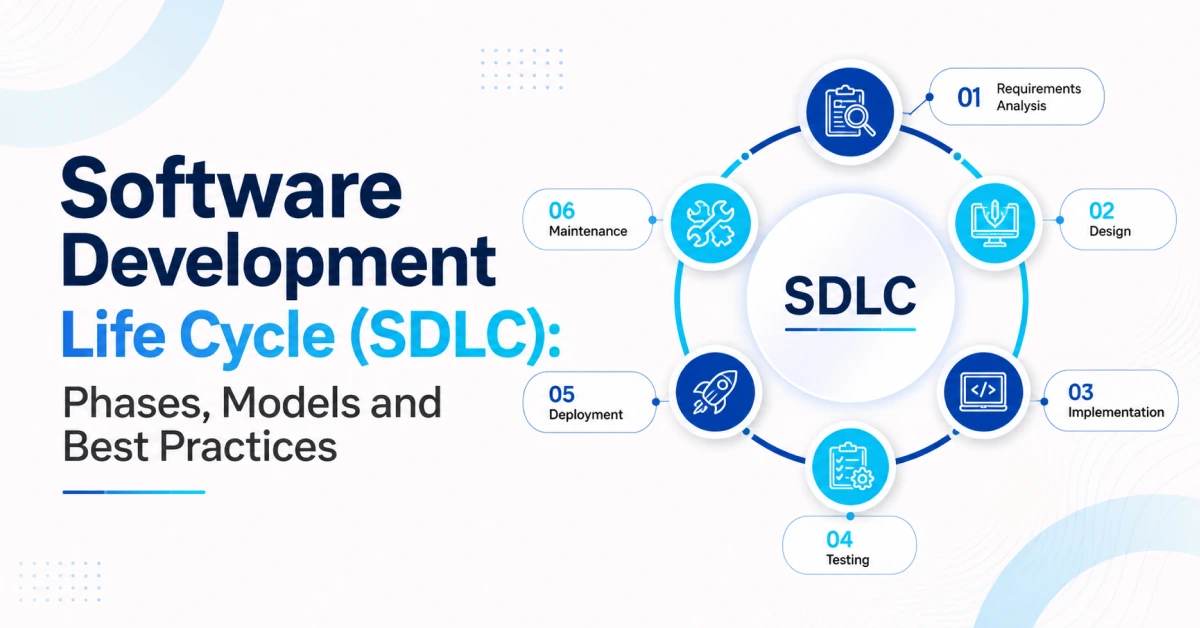
The 7 Phases of the SDLC
While different SDLC models organize phases differently, the core activities can be grouped into seven fundamental phases. Every software project, regardless of scale or methodology, must address each of these areas.
Phase 1: Planning and Requirements Gathering
The planning phase is the foundation of every successful software project. During this phase, the project team works with stakeholders to define the project scope, objectives, constraints, and success criteria. Key activities include feasibility analysis, resource estimation, timeline development, and risk assessment. Requirements are gathered through interviews, surveys, document analysis, and workshops.
In 2026, requirements gathering has been transformed by AI-powered tools that can analyze user behavior patterns, generate user stories from natural language descriptions, and identify potential conflicts in requirements before development begins. However, the human element remains critical—experienced business analysts and product managers must translate business needs into clear, testable requirements that the development team can execute. Our IT consulting services include requirements management support to help organizations define clear project scope.
Phase 2: System Design
In the design phase, the requirements are translated into a detailed system architecture. This includes high-level design (system architecture, technology stack decisions, data flow diagrams) and low-level design (database schemas, API specifications, component design). The design phase produces the blueprint that guides the development team throughout implementation.
Modern system design emphasizes modularity, scalability, and security from day one. Microservices architecture, API-first design, and event-driven patterns are common in 2026. Security considerations are integrated into the design through threat modeling, which identifies potential vulnerabilities before any code is written. Our cloud solutions team specializes in designing scalable, resilient architectures that can grow with your business.
Phase 3: Implementation (Coding)
During the implementation phase, developers write code according to the design specifications. Following modern SDLC best practices, development is organized into iterations or sprints, with each cycle producing a potentially shippable increment of the product. Version control systems like Git are used to manage code changes, and branching strategies such as GitFlow or trunk-based development provide structure for team collaboration.
Code quality is maintained through pair programming, code reviews, static analysis tools, and adherence to coding standards. In 2026, AI-assisted development tools like GitHub Copilot and Amazon CodeWhisperer have become standard parts of the developer toolkit, accelerating routine coding tasks while allowing developers to focus on complex logic and architectural decisions. However, human oversight remains essential—AI-generated code must be reviewed for security vulnerabilities, architectural consistency, and adherence to business requirements.
Phase 4: Testing
The testing phase validates that the software meets requirements and functions correctly across all expected scenarios. A comprehensive testing strategy includes multiple levels:
- Unit testing: Tests individual functions, methods, and components in isolation. Modern development teams aim for 80%+ code coverage, though coverage alone is not a quality metric—test quality matters more than quantity.
- Integration testing: Verifies that different components and services work together correctly. API contract testing ensures that service boundaries are properly maintained.
- System testing: Validates the complete, integrated system against requirements. This includes functional testing, performance testing, security testing, and usability testing.
- User acceptance testing (UAT): End users validate that the software meets their needs and is ready for production deployment. UAT is the final quality gate before release.
Automation is critical for efficient testing in 2026. CI/CD pipelines automatically run unit tests, integration tests, and security scans on every code commit. Test automation frameworks like Selenium, Cypress, and Playwright handle end-to-end testing for web applications. CloudMatrix’s web development practice includes comprehensive test automation to maintain quality at speed.
Phase 5: Deployment
The deployment phase moves the validated software from the development environment to production. Modern deployment practices emphasize automation, repeatability, and rollback capability. Key practices include:
Infrastructure as Code (IaC) tools like Terraform and AWS CloudFormation automate environment provisioning. Containerization with Docker and orchestration with Kubernetes provide consistent deployment across development, staging, and production environments. Blue-green deployments and canary releases enable safe rollouts with minimal user impact. Feature flags allow teams to control feature availability without code deployments.
A well-designed deployment pipeline can reduce release time from weeks to minutes while improving reliability. Continuous Delivery (CD) practices ensure that every code change is deployable to production, enabling teams to release value to users faster than ever before.
Phase 6: Operations and Maintenance
Software is never truly finished. The operations and maintenance phase encompasses all activities required to keep the software running reliably in production. This includes monitoring system health and performance, applying security patches, fixing bugs, and implementing minor enhancements.
In 2026, DevOps practices have evolved into platform engineering, with dedicated platform teams building internal developer platforms (IDPs) that streamline operations. Observability—the ability to understand system behavior through metrics, logs, and traces—has become a standard requirement for production systems. AIOps platforms use machine learning to detect anomalies, predict failures, and automate incident response.
Phase 7: Evaluation and Retirement
Eventually, every software system reaches the end of its useful life. The evaluation phase assesses whether the software continues to meet business needs. If the cost of maintenance exceeds the value delivered, or if the technology stack becomes obsolete, the system may be retired. A thoughtful retirement plan ensures that data is migrated, users are transitioned, and the system is decommissioned without disrupting business operations.
SDLC Models: Choosing the Right Approach
Different projects require different SDLC models. Here are the most widely used approaches in 2026:
Waterfall Model
The waterfall model follows a linear, sequential approach where each phase must be completed before the next begins. While largely superseded by agile methodologies for most projects, waterfall remains appropriate for projects with clear, stable requirements and strict regulatory compliance needs—such as defense systems, medical device software, and critical infrastructure. The waterfall model provides clear milestones, comprehensive documentation, and predictable timelines when requirements are well-understood from the outset.
Agile Model
The agile model is the dominant SDLC methodology in 2026, used by 71% of organizations according to the 15th Annual State of Agile Report. Agile embraces iterative development, continuous feedback, and adaptive planning. Scrum, Kanban, and SAFe (Scaled Agile Framework) are the most popular agile frameworks. Agile software development delivers value incrementally, with each iteration providing a potentially shippable product increment. This approach reduces risk by surfacing issues early and allows course correction based on user feedback.
V-Model (Verification and Validation)
The V-Model is an extension of the waterfall model that pairs each development phase with a corresponding testing phase. The left side of the “V” represents the verification phases (requirements, design), while the right side represents validation phases (testing, deployment). This model emphasizes test planning from the beginning of the project and is popular in safety-critical systems where comprehensive testing is mandatory.
Spiral Model
The spiral model combines iterative development with risk assessment. The project progresses through multiple cycles, with each cycle including: determining objectives, identifying and resolving risks, development and testing, and planning the next iteration. The spiral model is particularly well-suited for large, complex, high-risk projects where uncertainty is high and continuous risk assessment is essential.
DevOps Model
The DevOps model extends agile principles to the entire software delivery lifecycle, breaking down the traditional wall between development and operations. DevOps emphasizes automation, continuous integration and delivery (CI/CD), infrastructure as code, and a culture of shared responsibility for production systems. In 2026, DevOps has evolved into DevSecOps, with security integrated throughout the delivery pipeline rather than being a separate phase.
Best Practices for SDLC Success
Regardless of the SDLC model you choose, these best practices will improve project outcomes:
1. Involve stakeholders throughout the lifecycle. Regular communication with business owners, end users, and other stakeholders ensures that the software meets real needs. Conduct sprint reviews, demos, and feedback sessions at regular intervals. Stakeholder involvement reduces the risk of building the wrong product.
2. Implement continuous testing. Testing should begin in the planning phase and continue throughout the lifecycle. Shift-left testing practices bring testing earlier in the process, when defects are cheaper to fix. A bug found during the design phase costs 10-100 times less to fix than the same bug found in production.
3. Automate everything possible. Manual processes introduce errors and delays. Automate builds, testing, deployments, infrastructure provisioning, and monitoring. Every manual step in the delivery pipeline is a point of failure and a source of delay.
4. Prioritize security from the start. Security is not a phase—it is a continuous concern throughout the SDLC. Conduct threat modeling during design, perform static analysis during coding, run security tests during testing, and monitor for threats during operations. CloudMatrix’s cybersecurity services help organizations integrate security into every phase of the SDLC.
5. Maintain comprehensive documentation. While agile values working software over comprehensive documentation, some documentation is essential: architecture decisions, API specifications, deployment procedures, and runbooks. Use living documentation tools that stay synchronized with the code.
6. Measure and improve. Track metrics like deployment frequency, lead time for changes, mean time to recovery (MTTR), and change failure rate. Use these metrics to identify bottlenecks and continuously improve your SDLC process. The DORA metrics provide a standardized framework for measuring software delivery performance.
Common SDLC Challenges and How to Overcome Them
Scope creep: Uncontrolled changes to project scope are the leading cause of project delays and budget overruns. Combat scope creep with a formal change management process, clear prioritization, and a product backlog that stakeholders can see and influence. Every new feature request should be evaluated against its business value and impact on the project timeline.
Poor requirements: Unclear, incomplete, or contradictory requirements lead to rework and frustration. Invest in requirements engineering: user story workshops, acceptance criteria definition, and requirements validation with stakeholders. Consider using behavior-driven development (BDD) with Gherkin scenarios that provide executable specifications.
Communication breakdowns: Miscommunication among team members, stakeholders, and distributed teams causes errors and delays. Use collaboration tools like Jira, Confluence, and Slack effectively. Establish clear communication channels, meeting cadences, and escalation paths. Daily stand-ups, sprint planning, and retrospectives provide regular opportunities for alignment.
Technical debt: Shortcuts taken during development accumulate and slow future development. Manage technical debt intentionally—track it in your backlog, allocate capacity for refactoring, and establish quality gates that prevent excessive debt accumulation. Remember that technical debt, like financial debt, accrues interest.
Frequently Asked Questions About SDLC
Which SDLC model is best for my project?
The best SDLC model depends on your project characteristics. Agile is suitable for most projects with evolving requirements and a need for fast time-to-market. Waterfall works well for projects with stable, well-defined requirements and strict regulatory needs. The spiral model is appropriate for high-risk, complex projects. Consider factors like requirement stability, team size, risk tolerance, and regulatory requirements when making your choice.
How do I know if my SDLC process is effective?
Effective SDLC processes produce predictable outcomes: on-time delivery, within-budget costs, high quality, and satisfied stakeholders. Measure deployment frequency, lead time, mean time to recovery, and change failure rate (the four DORA metrics). Conduct retrospectives after each iteration to identify improvement opportunities. If your team consistently misses deadlines or delivers buggy software, your SDLC process needs adjustment.
What is the role of AI in modern SDLC?
AI is transforming every phase of the SDLC. AI-powered tools assist with requirements analysis, code generation, automated testing, security vulnerability detection, and production monitoring. In 2026, AI has become a standard productivity tool for development teams, but it augments rather than replaces human judgment. Critical thinking, architectural decisions, and stakeholder communication remain human responsibilities. The most effective teams use AI to handle routine tasks while focusing their energy on creative problem-solving and strategic decisions.
How does security fit into the SDLC?
Security must be integrated throughout the SDLC, not added as a final step before deployment. This approach, known as DevSecOps, incorporates security practices at every phase: threat modeling during design, static analysis during coding, dynamic testing during QA, vulnerability scanning before deployment, and continuous monitoring during operations. Integrating security early reduces costs and produces more secure software. The average cost of fixing a security vulnerability in production is 30 times higher than fixing it during design.
Can I combine multiple SDLC models?
Yes, hybrid SDLC approaches are common and often effective. For example, you might use agile development within a waterfall governance framework, combining the flexibility of iterative development with the predictability of phase-gate approvals. The key is to understand the strengths and weaknesses of each model and combine them intentionally, not accidentally. Document your hybrid approach clearly so all team members understand the process. CloudMatrix’s solutions team can help you design a tailored SDLC process that fits your organization’s unique needs.
Conclusion
The Software Development Life Cycle provides the structure, discipline, and predictability that software projects need to succeed. By understanding the phases, choosing the right model for your project, and following proven best practices, you can reduce risk, improve quality, and deliver software that meets business needs. Whether you are building a simple web application or a complex enterprise system, a well-defined SDLC is your roadmap to success. Contact CloudMatrix Technologies to learn how our experienced team can guide your next software development project from concept to launch and beyond.