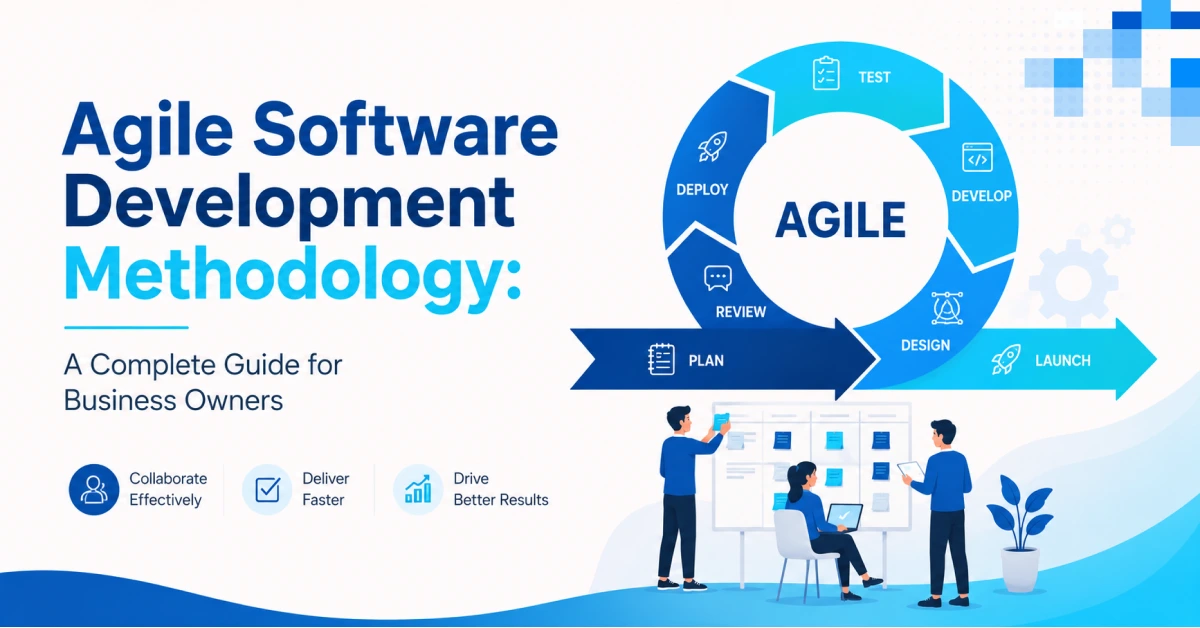
Agile Software Development Methodology: A Complete Guide for Business Owners in 2026
In today’s fast-paced digital landscape, business owners face a fundamental challenge: how to deliver high-quality software quickly while remaining responsive to changing market conditions. The Agile software development methodology provides the answer. Adopted by 71% of organizations worldwide, Agile has transformed how businesses build software, enabling faster delivery, higher quality, and better alignment with customer needs. At CloudMatrix Technologies, we help business owners leverage Agile methodologies to maximize their software investment and achieve measurable business outcomes.
What Is Agile Software Development?
Agile is an iterative approach to software development that emphasizes flexibility, collaboration, and customer satisfaction. Unlike traditional waterfall methods, which attempt to define all requirements upfront and then execute a linear plan, Agile embraces change and delivers value incrementally. The Agile Manifesto, published in 2001 by a group of forward-thinking software practitioners, established four core values:
- Individuals and interactions over processes and tools
- Working software over comprehensive documentation
- Customer collaboration over contract negotiation
- Responding to change over following a plan
These values are supported by 12 principles that guide Agile teams in their daily work. For business owners, understanding these principles is essential for engaging effectively with development teams and maximizing the return on their software investment.
Why Agile Matters for Business Owners
The business case for Agile is compelling. According to the Project Management Institute, organizations using Agile methodologies complete 28% more projects on time and 29% more within budget than those using traditional approaches. Furthermore, products built using Agile methods achieve 37% faster time-to-market and enjoy 31% higher customer satisfaction ratings.
For business owners, Agile provides several critical advantages:
Reduced risk. By delivering working software in short iterations (typically 1-4 weeks), Agile surfaces problems early when they are easier and cheaper to fix. A wrong assumption about user needs becomes apparent after a few sprints, not after months of development. This risk reduction translates directly to better budget predictability and fewer failed projects.
Faster time-to-market. Agile teams deliver a minimum viable product (MVP) quickly and then add features based on user feedback. This means you can start generating revenue, gathering user data, and building market presence months earlier than with traditional approaches. In competitive markets, this speed advantage can be the difference between market leadership and irrelevance.
Higher return on investment (ROI). Because Agile teams prioritize features based on business value, the most valuable functionality is delivered first. Even if the project’s budget is exhausted before all features are completed, the business has already received the highest-value features. This value-based approach maximizes ROI and ensures that every development dollar is spent on what matters most to the business.
Better alignment with customer needs. Agile’s emphasis on continuous customer involvement ensures that the product evolves in response to actual user feedback rather than assumptions made months earlier. Regular demos and feedback sessions keep stakeholders engaged and informed throughout the development process. This alignment reduces the risk of building a product that misses the mark with its target audience.
Key Agile Frameworks for Business Owners
Scrum
Scrum is the most widely adopted Agile framework, used by 66% of Agile organizations. It structures work into fixed-length iterations called sprints, typically 1-4 weeks long. Key roles include the Product Owner (who represents the business and prioritizes the backlog), the Scrum Master (who facilitates the process), and the Development Team (who build the product). Key events include Sprint Planning, Daily Scrum, Sprint Review, and Sprint Retrospective.
For business owners working with Scrum teams, the Product Owner role is particularly important. This individual serves as the bridge between business strategy and technical execution, making prioritization decisions that maximize business value. In many organizations, the Product Owner role is filled by a business stakeholder or a dedicated product manager who works closely with business leadership.
Kanban
Kanban is a flexible Agile framework that focuses on visualizing work, limiting work in progress, and optimizing flow. Unlike Scrum, Kanban does not prescribe fixed-length iterations. Instead, work items flow continuously through a pipeline, and the team pulls new work only when capacity is available. Kanban is particularly well-suited for maintenance projects, support teams, and environments where priorities change frequently.
For business owners, Kanban provides excellent visibility into team capacity and work progress. The Kanban board—whether physical or digital—shows exactly what the team is working on, what is coming next, and where bottlenecks exist. This transparency helps business owners make informed decisions about priorities and resource allocation.
SAFe (Scaled Agile Framework)
SAFe provides a structured approach for applying Agile at enterprise scale. It coordinates multiple Agile teams—potentially hundreds of people—working on the same product or product suite. SAFe introduces additional roles (Release Train Engineer, Solution Architect) and events (Program Increment Planning, System Demo) that enable alignment across teams while preserving the flexibility that makes Agile effective at the team level.
For business owners in larger organizations, SAFe offers the scalability needed to coordinate complex, multi-team initiatives. It provides a framework for strategic planning that connects business objectives to team execution, ensuring that all teams are working toward common goals.
The Agile Development Process: What Business Owners Should Expect
Understanding the Agile development process helps business owners engage effectively with their development teams. Here is what a typical Agile engagement looks like at CloudMatrix Technologies:
Project Initiation and Backlog Creation
The project begins with a discovery phase where we work with you to understand your business goals, target users, and success criteria. We create an initial product backlog—a prioritized list of features, user stories, and technical tasks. Each item in the backlog includes acceptance criteria that define what “done” means from both a functional and business perspective.
During this phase, we define the product vision, identify key performance indicators (KPIs), and establish the high-level roadmap. The output is a shared understanding of what we are building, why we are building it, and how we will measure success. This phase typically takes 1-3 weeks, depending on project complexity.
Sprint Planning
At the beginning of each sprint, the team meets for Sprint Planning. The Product Owner presents the highest-priority backlog items, and the team commits to delivering a specific set of features during the sprint. The team breaks each feature down into specific tasks and estimates the effort required. Business owners or their representatives participate in Sprint Planning to ensure priorities are correctly aligned with business needs.
Development and Daily Coordination
During the sprint, developers build, test, and integrate the features they committed to delivering. The team holds a brief Daily Scrum (stand-up) each day where team members discuss progress, plans, and obstacles. Business owners do not typically attend daily stand-ups, but they receive regular progress updates through the Scrum Master or Product Owner.
Sprint Review and Demo
At the end of each sprint, the team demonstrates the completed work to stakeholders in a Sprint Review. This is the business owner’s opportunity to see working software, provide feedback, and influence the direction of the next sprint. The Sprint Review is not a formal approval gate—it is a collaborative discussion where the team and stakeholders together assess progress and adjust priorities based on what they see.
Sprint Retrospective
After the Sprint Review, the team conducts a Sprint Retrospective—a private session focused on process improvement. The team discusses what went well, what could be improved, and what actions they will take in the next sprint to work more effectively. While business owners typically do not attend retrospectives, they benefit from the continuous improvement that this practice enables.
Measuring Agile Success: KPIs for Business Owners
To evaluate whether Agile is delivering value for your business, track these key performance indicators:
- Velocity: The amount of work a team completes in each sprint. Velocity helps with forecasting and capacity planning. Stable velocity over multiple sprints indicates a well-functioning team.
- Sprint burndown: A chart showing remaining work versus time in the sprint. A burndown that trends toward zero at the end of the sprint indicates the team is on track to deliver its commitments.
- Cycle time: The time from when work starts on a task until it is completed. Shorter cycle times mean faster delivery of value to users.
- Defect rate: The number of bugs found after release. A low defect rate indicates high code quality and effective testing practices.
- Customer satisfaction: Measured through surveys, NPS scores, or user engagement metrics. Ultimately, the most important measure of Agile success is whether users are happy with the product.
CloudMatrix’s IT consulting and training includes helping business owners establish and track these metrics effectively.
Common Agile Challenges and How to Address Them
While Agile offers significant benefits, it also presents challenges that business owners should understand:
1. Scope management. Agile’s flexibility can lead to scope creep if the Product Owner or business stakeholders continuously add new requirements without deprioritizing existing work. Address this by maintaining a strict cost-per-sprint model: if new features are added, existing features of equivalent effort must be removed. Every sprint has a fixed capacity, and trade-offs must be explicit.
2. Stakeholder availability. Agile requires active business stakeholder participation in Sprint Reviews, backlog refinement, and user acceptance testing. If key stakeholders are unavailable, the team loses critical guidance and the product may drift from business needs. Ensure that at least one business stakeholder has dedicated time for Agile participation throughout the project.
3. Cultural resistance. Shifting from traditional project management to Agile requires a cultural change. Teams accustomed to detailed specifications and fixed plans may struggle with Agile’s emphasis on adaptation and collaboration. Invest in training, coaching, and leadership support to facilitate the transition. Our solutions include Agile transformation support to help organizations make this transition smoothly.
4. Distributed teams. Agile was designed for co-located teams, but many organizations now work across multiple locations. Overcome this challenge with robust collaboration tools, overlapping working hours, regular video communication, and occasional in-person gatherings for critical events like PI Planning or Sprint reviews.
Agile Contracts: What Business Owners Need to Know
Traditional fixed-price contracts are often incompatible with Agile’s iterative nature. Consider these Agile-friendly contracting models:
Time and materials: You pay for the actual development time spent. This model provides maximum flexibility but requires trust in the development team’s productivity. It works best when requirements are expected to evolve significantly.
Fixed-price per sprint: You agree on a fixed cost per sprint (based on team size and sprint length) and control scope through backlog prioritization. This model provides budget predictability while maintaining flexibility on features.
Fixed-price with Agile governance: The overall project budget is fixed, but the scope is managed through Agile prioritization. The team commits to delivering the highest-priority features within the fixed budget. This approach balances budget certainty with the flexibility to adapt to changing needs.
CloudMatrix Technologies offers flexible engagement models that align with Agile principles, giving business owners budget certainty without sacrificing the adaptability that makes Agile valuable.
Frequently Asked Questions About Agile for Business Owners
How is Agile different from traditional Waterfall development?
Waterfall follows a linear, sequential process where all requirements are defined upfront, then the product is designed, built, tested, and deployed in phases. Agile works in short iterative cycles, with requirements evolving throughout the project based on user feedback and business needs. Waterfall prioritizes predictability and documentation; Agile prioritizes flexibility and working software. Waterfall is better suited for projects with stable, well-understood requirements; Agile excels when requirements are expected to change.
How long does an Agile project take?
Unlike waterfall projects with a fixed end date, Agile projects run in continuous cycles of delivery and improvement. Business owners should think in terms of releases rather than a single end date. An MVP might be ready in 8-12 weeks, with additional functionality delivered in subsequent releases. The ongoing nature of Agile means you can start realizing value from your investment much sooner than with traditional approaches.
How much does Agile software development cost?
Agile development costs vary based on team size, location, and project complexity. Typical rates for a dedicated Agile team range from $80,000 to $200,000 per month for a full squad (product owner, 4-6 developers, QA, Scrum Master/tech lead). However, costs scale down proportionally for smaller teams or part-time engagements. The key advantage of Agile is that you see working software early and can stop investing if the business case changes, reducing financial risk.
Can Agile work for non-software projects?
Yes, Agile principles have been successfully applied to marketing campaigns, product launches, event planning, and many other business domains. The core concepts—iterative delivery, continuous feedback, cross-functional collaboration, and value-based prioritization—are universally applicable. However, Agile is most effective when the work involves creativity, complexity, and uncertainty—precisely the conditions where traditional project management approaches struggle.
How do I choose the right Agile development partner?
Look for a partner with demonstrated Agile expertise, relevant domain experience, and a collaborative approach. Ask about their Agile certifications (CSM, CSPO, SAFe), their experience with distributed teams, and how they handle scope changes. Request references from clients in similar industries. At CloudMatrix, our experienced team brings deep Agile expertise across multiple industries and project types. Contact us to discuss how we can help your business succeed with Agile.
Conclusion
Agile software development methodology has become the standard for building software in 2026—and for good reason. Its emphasis on collaboration, flexibility, and value-driven delivery aligns perfectly with the needs of modern businesses operating in fast-changing markets. By understanding Agile principles, frameworks, and best practices, business owners can engage more effectively with development teams, reduce project risk, and achieve better business outcomes. Contact CloudMatrix Technologies today to start your Agile development journey with a partner who understands both technology and business.