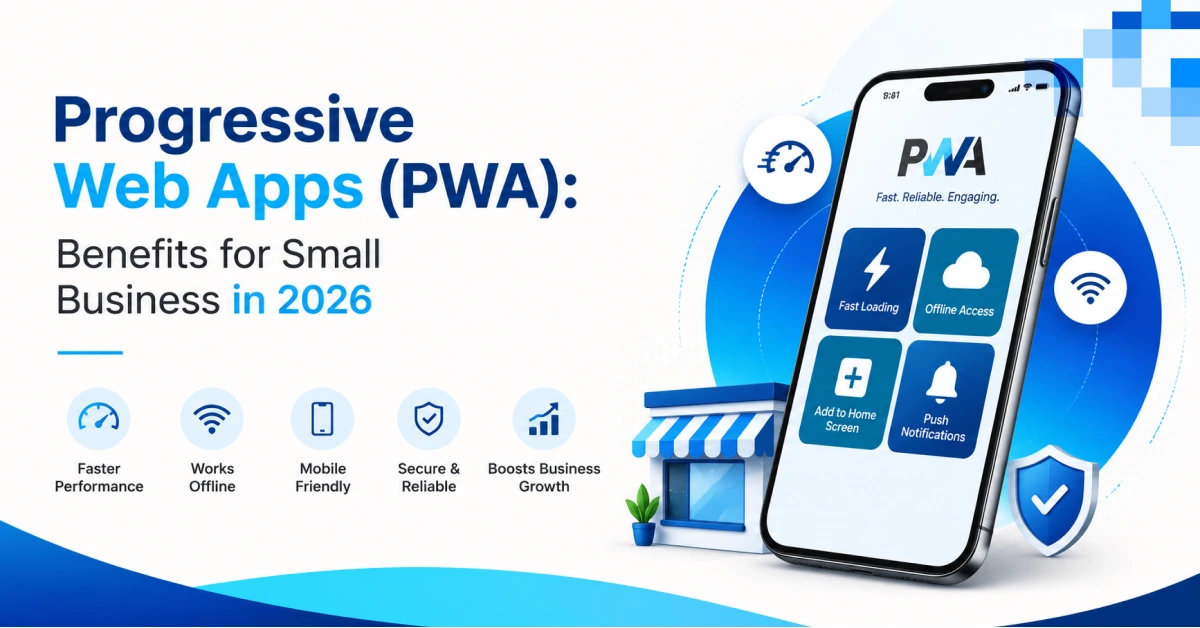
Progressive Web Apps (PWAs) have emerged as one of the most transformative technologies for small businesses in 2026. Combining the best features of websites and native mobile applications, PWAs deliver app-like experiences directly through the browser — no app store downloads, no installation friction, and no 30% Apple/Google commission fees. With 63% of all web traffic now coming from mobile devices and the average user having 80+ apps installed but using only 9 per day, the barrier to native app adoption is higher than ever. PWAs solve this problem by offering instant loading, offline functionality, push notifications, and home screen installation — all through a standard website. For small to medium businesses in Boston competing with larger enterprises, PWAs level the playing field by delivering premium mobile experiences at a fraction of the cost of native app development.
What Is a Progressive Web App?
A Progressive Web App is a website built with modern web technologies that behaves like a native mobile application. Unlike traditional websites, PWAs use a service worker (a JavaScript file running in the background) to enable features like offline access, background sync, and push notifications. They include a web app manifest (a JSON file) that controls how the app appears when installed on a user’s device — defining icons, splash screen, theme color, and display mode. First popularized by Google in 2015, PWAs have matured dramatically by 2026. Major companies including Twitter (X), Spotify, Pinterest, Starbucks, and Telegram have adopted PWAs, reporting conversion rate increases of 36–52% and significant improvements in user engagement metrics. At CloudMatrix Technologies, we build PWAs as part of our comprehensive web development services and have seen firsthand how they transform mobile engagement for our small business clients. The technology has evolved to the point where PWAs now support features like push notifications on iOS, background synchronization, and file system access, making them viable alternatives to native apps for most business use cases.
Why Small Businesses Need PWAs in 2026
The mobile landscape in 2026 presents both challenges and opportunities for small businesses. Mobile commerce reached $2.3 trillion globally in 2025, with projections exceeding $3 trillion by 2027. However, the average mobile site abandonment rate remains at 53% — largely due to slow loading times, poor navigation, and checkout friction. PWAs address these issues head-on. A PWA loads in under 2 seconds (compared to the average 15-second load time for a typical mobile website), provides smooth animations and transitions, and works reliably even on slow or intermittent network connections. For a small business owner in Boston trying to attract local customers browsing on their phone during a commute, a PWA can mean the difference between a new customer and a lost opportunity. The ability to deliver a seamless, app-like experience without requiring users to download anything from an app store is a powerful competitive advantage for small businesses with limited marketing budgets.
The Cost Advantage
Building a native iOS and Android app typically costs between $50,000 and $150,000 for a minimum viable product, with ongoing maintenance adding 15–20% of the initial development cost annually. A PWA, by contrast, can be developed for $5,000–$25,000 — often as an enhancement to an existing website. Since PWAs are built with standard web technologies (HTML, CSS, JavaScript), they work across all platforms with a single codebase. This eliminates the need for separate iOS and Android development teams and allows small businesses to deploy updates instantly without app store review processes that can take days or weeks. For a typical small business, this cost differential can be redirected toward marketing, inventory, hiring, or other growth initiatives. The return on investment for PWAs is often realized within months rather than years.
Key Benefits of Progressive Web Apps for Small Businesses
1. Instant Loading and Improved Performance
PWAs leverage service worker caching strategies to deliver near-instant loading. On repeat visits, the PWA loads from the cache, eliminating network latency. According to Google’s case studies, PWAs have reduced load times by up to 84% compared to traditional mobile websites. Pinterest’s PWA saw a 40% increase in time spent, a 60% increase in core engagements, and a 44% increase in user-generated ad revenue. For a small business, faster load times directly correlate with higher conversion rates — every 100ms improvement in load time can increase conversion rates by up to 9% according to Amazon’s internal research. This performance advantage is especially critical for businesses relying on mobile traffic, where users expect pages to load in under 3 seconds.
2. Offline Functionality
One of the most powerful features of PWAs is the ability to work offline or on low-quality networks. Service workers cache critical resources during the initial visit, enabling users to browse previously viewed content, fill out forms, and even complete transactions without an internet connection. When connectivity is restored, cached actions are synchronized with the server. For a small business whose customers might be browsing from areas with poor cell coverage — trade shows, rural locations, subway systems — offline capability ensures the user experience is never compromised. A local restaurant’s PWA could allow customers to browse the menu while riding the Boston T, even without a data connection. This resilience builds customer trust and reduces bounce rates significantly.
3. No App Store Required
PWAs bypass the traditional app store ecosystem entirely. Users discover PWAs through search engines, social media, or direct links — the same channels they use to find any website. When a user visits a PWA, they receive a prompt to “Add to Home Screen,” creating an app icon on their device without visiting Google Play or the Apple App Store. This eliminates the app store approval process, commission fees (PWAs bypass Apple’s 15–30% App Store commission on digital purchases), and the friction of downloading and installing yet another app. For small businesses with limited marketing budgets, the organic discovery potential of PWAs is a significant advantage over native apps that require paid user acquisition campaigns. Users are far more likely to try a PWA that loads instantly from a search result than to download a native app requiring registration and permissions.
4. Push Notifications for Re-engagement
PWAs support push notifications, enabling businesses to re-engage users with time-sensitive offers, order updates, appointment reminders, or content announcements. Push notifications have an average opt-in rate of 30–60% on the web (compared to 60–80% on native iOS and 80–90% on Android), but they do not require the user to have installed an app — just a visit to the website with opt-in. For a small business, a well-timed push notification can drive repeat visits and increase customer lifetime value. A PWA push campaign costs a fraction of email or SMS marketing while delivering comparable or better engagement rates. According to a 2025 Leanplum study, push notifications drive a 20% increase in app opens and a 15% boost in conversions. Implementing push notifications through a PWA is straightforward and can be integrated with existing marketing automation tools.
5. Enhanced Security
PWAs are served exclusively over HTTPS, which encrypts all data transmitted between the user’s device and your server. This protects against man-in-the-middle attacks and ensures sensitive customer information — payment details, personal data, login credentials — remains secure. Additionally, the service worker architecture provides a natural security boundary; service workers operate in their own context and cannot access the DOM directly, reducing the risk of cross-site scripting (XSS) vulnerabilities. For small businesses that handle customer data, PWAs offer a security posture that is inherently stronger than many traditional mobile web applications. The HTTPS requirement also boosts SEO rankings, as Google treats HTTPS as a ranking signal.
6. Improved SEO and Discoverability
Unlike native apps, which are indexed separately from websites, PWAs are fully indexed by Google and other search engines. This means your PWA content appears in search results, drives organic traffic, and benefits from your existing SEO strategy. Google has confirmed that PWAs are treated favorably in search rankings, particularly on mobile, where page speed and user experience are ranking factors. Additionally, PWAs that meet Google’s PWA checklist requirements (serving over HTTPS, having a web app manifest, and registering a service worker) may receive enhanced placement in Google Search results and Google Discover. For a small business looking to maximize organic reach without a large advertising budget, the SEO benefits of PWAs are compelling and measurable.
Real-World PWA Success Stories for Small Businesses
Starbucks built a PWA that reduced data consumption by 96% on low-end networks, enabling ordering from areas with poor connectivity. The result was a 50% increase in daily active mobile users and seamless offline menu browsing. Flipkart (India’s largest e-commerce platform) launched a PWA that achieved a 70% increase in conversions and a 40% higher re-engagement rate compared to their native app. Lancôme’s PWA delivered a 50% increase in mobile sessions and a 17% increase in conversion rate. For a small business, these metrics translate into real revenue growth. Our portfolio showcases small business websites we have developed with PWA capabilities that deliver measurable results for Boston-area clients. Even a modest 10–20% improvement in mobile conversion rates can represent thousands of dollars in additional annual revenue for a typical small business.
How to Implement a PWA for Your Small Business
Implementing a PWA does not require rebuilding your website from scratch. If you already have a WordPress or custom website, you can progressively enhance it with PWA features. Essential components include an SSL certificate to serve your site over HTTPS (already standard practice), a web app manifest JSON file that defines your app name, icons, and theme color, a service worker JavaScript file for caching and offline support, and responsive design that works across all screen sizes. For WordPress sites, plugins can automate much of this process, but a custom implementation by a professional development team ensures optimal performance and full feature utilization. CloudMatrix Technologies offers PWA development as part of our web development and software development services.
PWA vs Native App: Which Is Right for Your Small Business?
PWAs are ideal for content-oriented businesses, e-commerce stores, service providers, restaurants, local shops, media and publishing, and any business where the primary interaction is browsing, reading, or filling forms. Native apps remain preferable for hardware-intensive applications (gaming, augmented reality, camera-heavy apps), complex offline data processing, and applications requiring deep platform integration (Bluetooth, NFC, advanced sensor access). Many successful businesses adopt a hybrid approach — offering a PWA as the primary mobile experience and building native apps only when the business case justifies the investment. Explore our solutions to see how we help businesses choose the right mobile strategy for their specific needs and budget constraints.
The Future of PWAs: What to Expect Beyond 2026
The Web Capabilities project (Project Fugu) continues to close the gap between web and native apps. Emerging PWA capabilities in 2026 include file system access, clipboard API improvements, WebUSB and WebBluetooth expansions, background fetch for large downloads, and improved payment integration through the Payment Request API. Operating system support continues to grow — recent versions of iOS now provide robust PWA support including push notifications and background sync, addressing the historical weakness on Apple devices. As browser engines continue to advance, the functional gap between PWAs and native apps will narrow further, making PWAs an increasingly attractive option for small businesses. Forward-thinking business owners who adopt PWAs now will be well-positioned to leverage these emerging capabilities as they become available.
Frequently Asked Questions (FAQ)
Do Progressive Web Apps work on iPhones and iPads?
Yes. Apple’s Safari on iOS 16.4+ provides comprehensive PWA support, including push notifications, full-screen display, and improved caching. While iOS PWA support historically lagged behind Android, significant improvements in recent years have made PWAs fully functional on Apple devices. Users can add PWAs to their iPhone or iPad home screen just like on Android.
Can a PWA replace my small business website?
A PWA is an enhanced version of your website, not a replacement. It builds upon your existing web presence, adding app-like capabilities while maintaining full website functionality. Most small businesses implement PWAs as a progressive enhancement to their responsive website, ensuring both traditional web visitors and PWA users have excellent experiences.
How much does it cost to build a PWA for a small business?
Basic PWA implementation for an existing website typically costs $3,000–$10,000. A fully custom PWA with advanced features can range from $10,000 to $30,000. This is significantly less than the $50,000–$150,000+ required for a native app with equivalent functionality. Ongoing maintenance costs are similar to regular website maintenance since PWAs use standard web technologies.
Do PWAs rank in Google search results?
Yes, PWAs are fully indexed by Google and rank in search results just like any other website. In fact, Google has publicly favored PWAs because they provide excellent mobile user experiences — and mobile-friendliness is a confirmed ranking factor. Additionally, PWAs can appear in Google Discover, providing extra organic visibility.
What industries benefit most from PWAs?
E-commerce, hospitality, restaurants, local services, media/publishing, education, healthcare scheduling, and professional services benefit most. Any business where customers need fast, reliable access to content or services on mobile devices will see improved engagement and conversions from PWA implementation. Contact us to discuss how a PWA can benefit your specific business.